
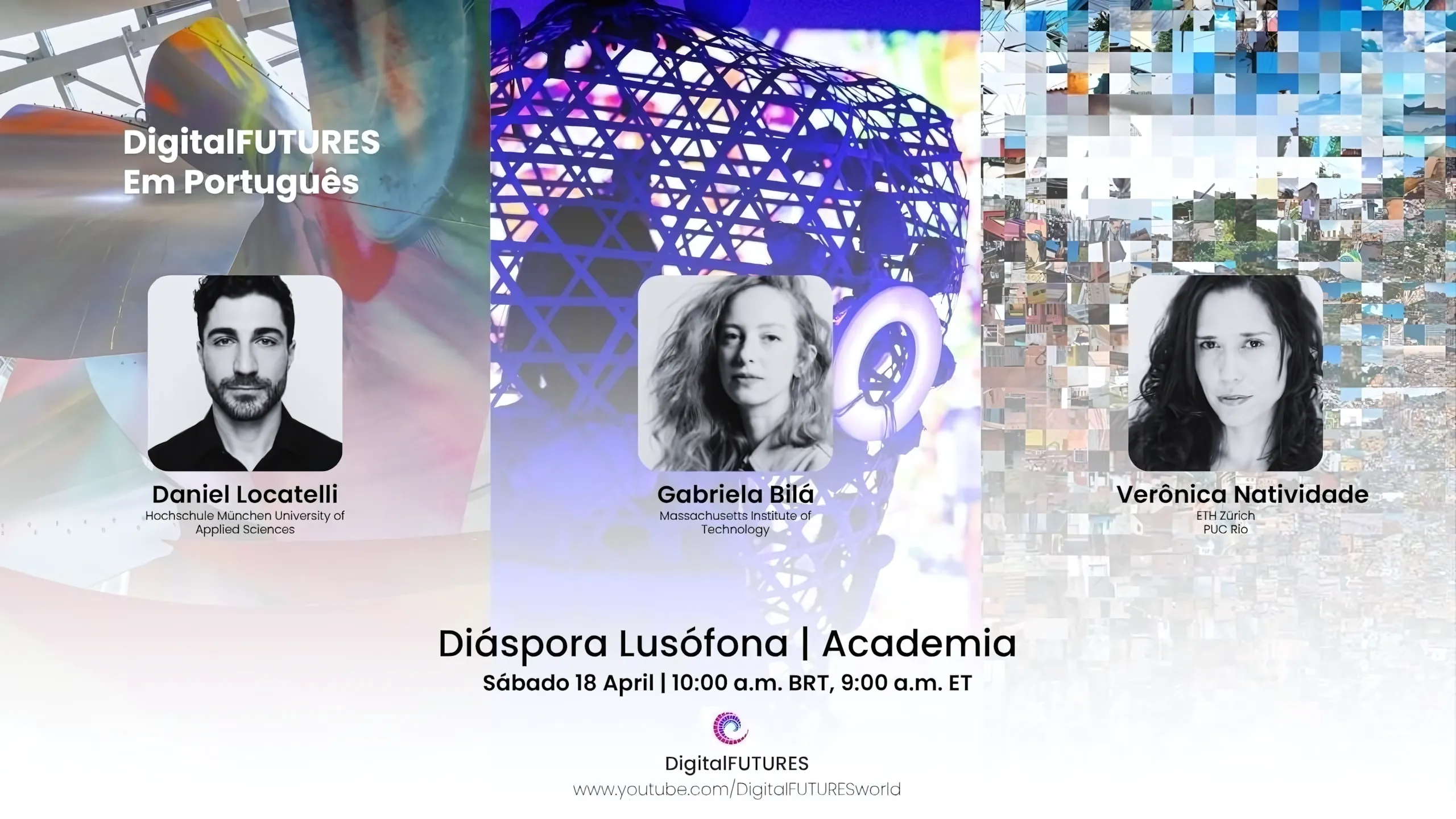
Digital Futures 2026: Entre o Prompt e a Obra
| Date | |
|---|---|
| Last updated | |
| Organization | DigitalFUTURES |
| Authors | Daniel Nunes Locatelli, Gabriela Bilá, Verônica Natividade |
| Coordinators | Angelica Paiva Ponzio (Organizing Committee), Daniela Silva, Leonardo Prazeres Veloso de Souza, Ricardo Cesar Rodrigues, Henrique Lattes Borçato |
| Place | Online |
| Language | Portuguese |
This Digital Futures 2026 session, Lusophone Diaspora (Academia), gathered three Brazilian researchers based abroad: Verônica Natividade (ETH Zürich, PUC Rio), Gabriela Bilá (MIT Media Lab), and myself, presenting the talk Entre o Prompt e a Obra (Between the Prompt and the Built Work) from Munich.
I traced my path from biomimicry to systems thinking. At Atelier Marko Brajovic in São Paulo, where I spent almost six years, I learned to read architecture through the three layers of biomimicry described by Janine Benyus: reproducing forms (e.g., the diatom-inspired Porte Monumentale of the 1900 World’s Fair), reproducing processes (Gaudí’s catenary form finding, material computation), and reproducing ecosystems. The third layer only became clear to me later, in Germany.
At ITECH, I studied with Achim Menges and absorbed the idea of co-design: not just optimizing form, but treating materials, fabrication, and structure as parts of one system. My master’s thesis with Nils Opgenorth prototyped a multi-scale robotic system for gluing cross-laminated timber panels directly on site, including a cooperation with a spider-crane automation institute and a study of the pressure required for the glue to cure.
In practice, at Alfred Rein Engineers and ArtEngineering, I worked on form finding of tensile structures and on built work by Olafur Eliasson and Katharina Grosse. One project stuck with me: Grosse’s leather model bent in two directions, but the steel sheets we had to fabricate only bend in one (a developable surface), so a single weekend of form finding had to reconcile the two. Even with very advanced fabrication, the design pipeline still starts with paper sketches and ends in PDFs, a real gap between design and fabrication.
At BuildSystems, a Munich startup, we built Grasshopper plugins for life-cycle assessment and urban analysis, plus a web app for the KfW funding that rewards timber construction. The most lasting lesson was about ontologies: how to represent building data so it survives instead of getting lost in PDFs and spreadsheets.
Today, at Munich University of Applied Sciences, I am building an app that manages timber-construction data through this ontological approach. My closing provocation: AI harnesses, the layer beyond co-design, are how these heterogeneous systems will start to connect. I also announced that I will be starting a PhD at ETH Zürich, where Verônica did hers.
The full session is available on YouTube via the link above.
