
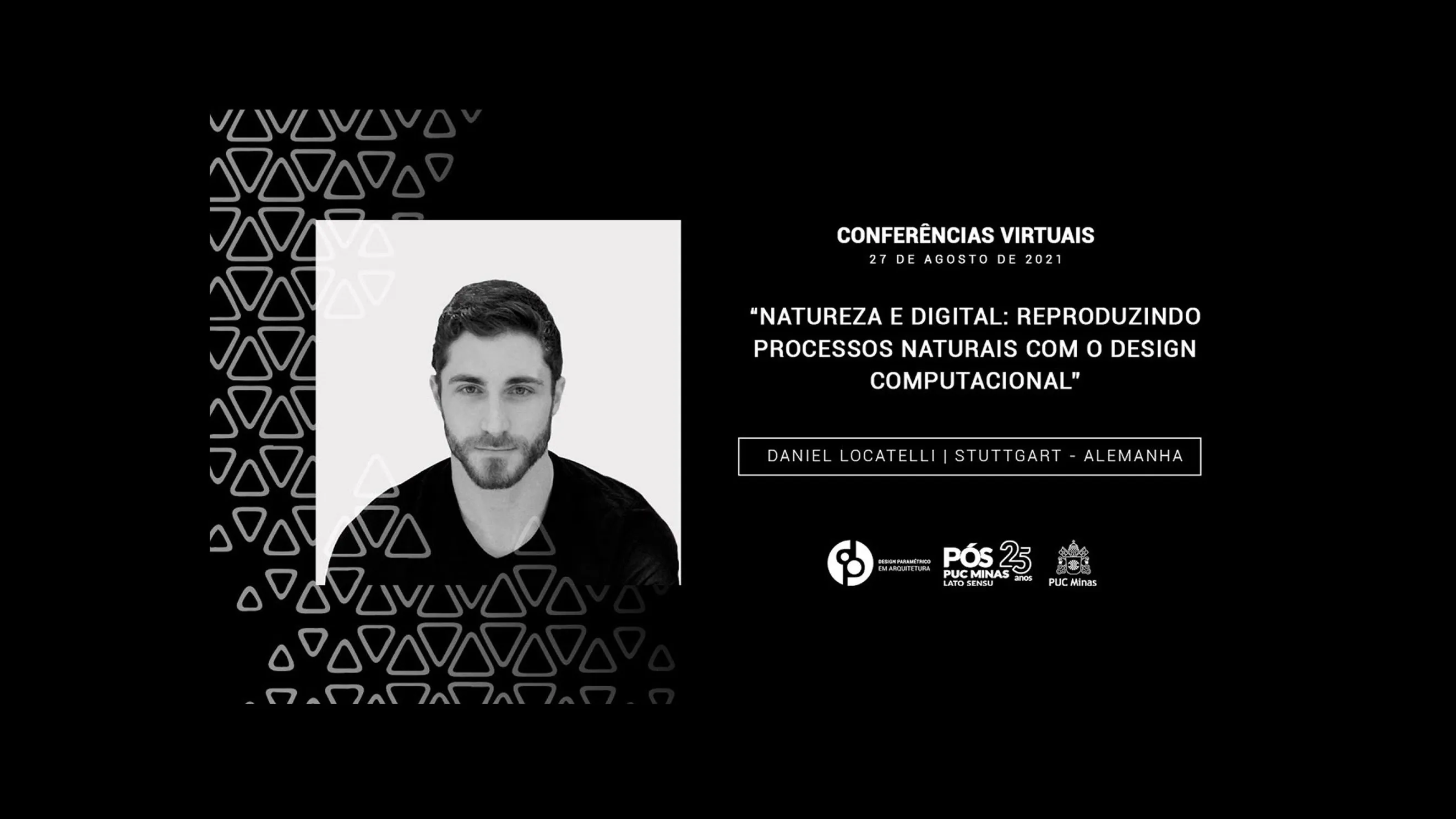
Nature and Digital: Reproducing Natural Processes with Computational Design
| Date | |
|---|---|
| Last updated | |
| Author | Daniel Nunes Locatelli |
| Place | PUC Minas - Online |
| Location | Belo Horizonte, Brazil |
| Language | Portuguese |
This talk, part of the “Design Paramétrico em Arquitetura” event at PUC Minas, explored how computational design can reproduce natural processes and the lessons learned during my master’s research at the University of Stuttgart.
Computational Design Terminology
The presentation began by clarifying the terminology around computational design, distinguishing between associative modeling, parametric design, algorithmic design, and generative design. It referenced David Rutten’s 2012 mental map, where the creator of Grasshopper attempted to identify and connect these various terms.
Professional Trajectory
I shared my academic and professional journey: from UNEMAT (2007-2008) and FAU-USP (2010-2016), through an exchange at Auburn University and an internship at CSULB in California, to projects at Atelier Marko Brajovic including Ekóa Park, Parada Coca-Cola, the O3 Pavilion, Casa Asha, and Nike Air Guitar.
Biomimicry in Architecture
The core of the talk focused on biomimicry as defined by Janine Benyus, structured around three levels: reproducing forms, reproducing processes, and reproducing ecosystems. I discussed how pioneers like Robert Hooke, Antoni Gaudí (with his funicular models for the Colônia Güell and Sagrada Família), Frei Otto (with soap film experiments), Sergio Musmeci, and Pier Luigi Nervi used physical models to find structurally efficient forms. The talk also covered contemporary computational design references such as Luigi Moretti, John Frazer, Achim Menges, and Neri Oxman, and introduced the concept of material computation: collaborating with the physical world rather than trying to dominate it.
ITECH Master Program and 10 Lessons Learned
I presented my experience at the ITECH Master Program at the University of Stuttgart and shared ten key takeaways from studying in Germany: the strong connection between universities and industry, the role of demonstrators and pavilions, interdisciplinary research culture, bottom-up versus top-down processes, the importance of seeing the big picture, the search for a new aesthetic of wood, the fact that artificial intelligence is not magic, biomimicry as a means rather than an end, the concept of digital vernacular, and the value of reflection. The talk concluded with a discussion on how these lessons could be applied in Brazil, considering local materials such as massive wood, earth, brick, and bamboo.
